
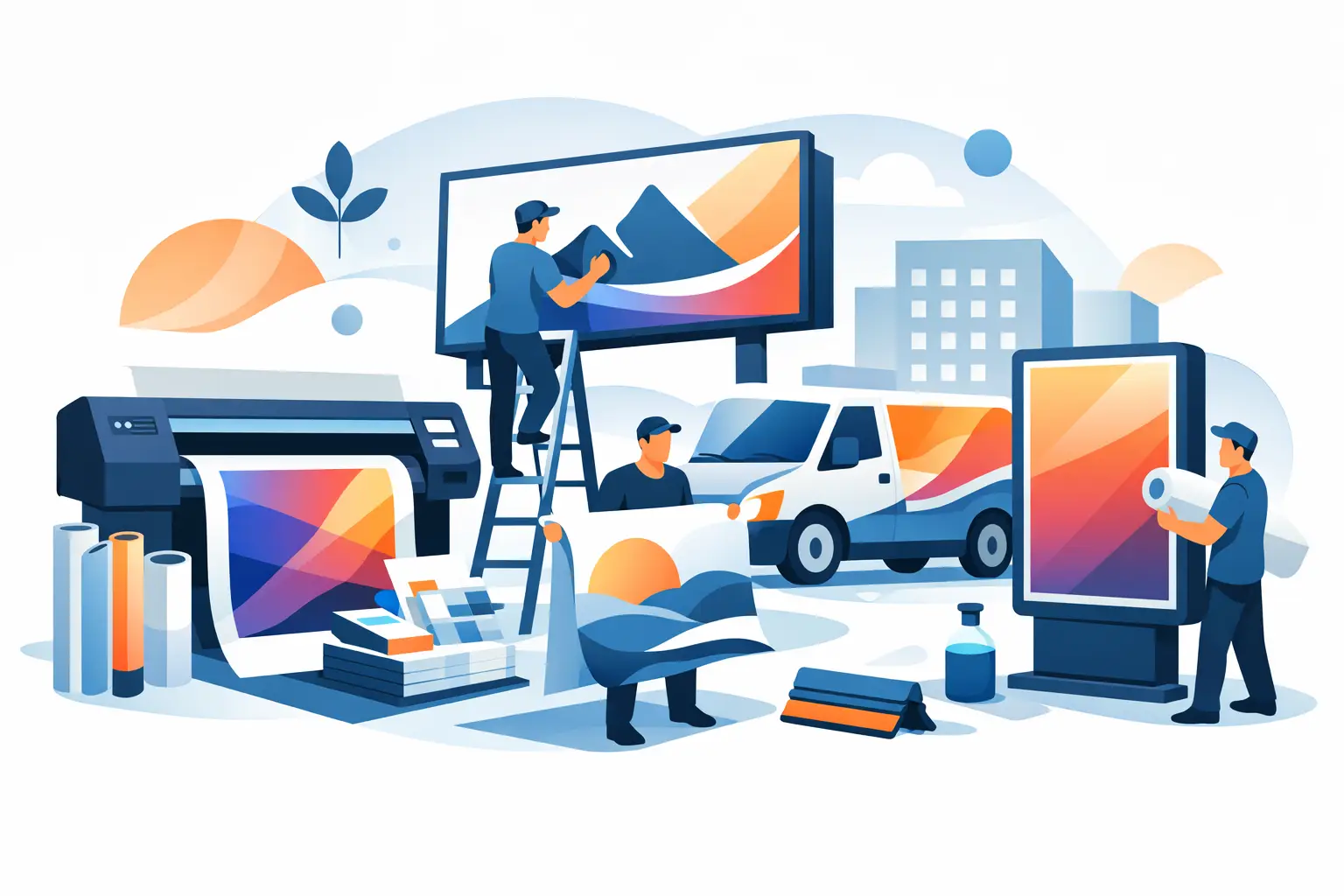
Printing and Signage Services That Perform
A banner that arrives late, a booth wall with the wrong finish, or directional signs that confuse visitors instead of guiding them – these are small failures that create a very visible problem. For brands investing in exhibitions, conferences, retail activations, and corporate events, printing and signage services are not just support materials. They are part of the experience, part of the operations, and part of how people judge your brand in real time.
That is why strong execution matters as much as strong design. When print and signage are planned correctly, they do more than fill space. They direct movement, reinforce brand identity, improve audience engagement, and help every touchpoint feel intentional.
Why printing and signage services matter more than most teams expect
Many organizations still treat print as a final-stage production task. The creative is approved, the event date is set, and then the printing request goes out. In practice, that approach creates risk. Print and signage affect layout planning, installation timing, visibility, compliance, and even the pace of on-site operations.
At an exhibition, signage supports more than branding. It helps attendees find your space, understand your offer, and move through the environment without friction. At a corporate event, printed materials often carry the burden of clarity – from welcome signage and agenda boards to branded backdrops and stage graphics. In retail or promotional campaigns, visibility, durability, and finish directly influence how professional the brand appears.
This is where businesses benefit from working with a partner that understands the full project environment, not just the print file. The best outcomes come from aligning creative direction, production specifications, site conditions, and installation logistics from the beginning.
What effective printing and signage services should actually deliver
Quality starts with consistency. A brand should look like itself across every format, whether that means a reception sign, a window graphic, a brochure, a floor decal, or a large-format exhibition wall. Color accuracy, material selection, sizing, and finishing all need to work together. If one element looks premium and another looks rushed, the audience notices.
Speed matters too, but speed without control creates expensive mistakes. Reliable printing and signage services should combine turnaround capability with production discipline. That means checking artwork correctly, matching specifications to the use case, and coordinating installation so the final result works in the real space, not just on screen.
Durability is another point many teams underestimate. Indoor and outdoor signage perform differently. Temporary campaign graphics require one approach, while long-term branded installations require another. The right substrate, print method, and finish depend on where the asset will be used, how long it needs to last, and what conditions it will face.
There is also a strategic layer. Good signage is not only visible. It is purposeful. It should support the customer journey, reduce confusion, highlight priorities, and strengthen recall. In that sense, production quality and communication strategy are closely connected.
Printing and signage services for events and exhibitions
In event environments, timing is unforgiving. A missed delivery window or a problem during installation can affect the full launch sequence. That is why event printing requires a different level of coordination than standard commercial print work.
Exhibition graphics need to fit built structures precisely. Stage backdrops must read well in person and on camera. Wayfinding signage must be clear from a distance and positioned according to traffic flow. Branded panels, podium graphics, registration counters, tent cards, and promotional handouts all need to feel like part of one system.
This is also where integration becomes valuable. When the same partner understands event production, branding, and print execution, fewer details fall between vendors. Design choices can be matched to fabrication realities early. Technical issues can be solved before they become on-site delays. For businesses managing launches, trade shows, or high-visibility corporate events, that coordination is often the difference between a polished presentation and a stressful one.
How to choose the right materials and formats
Not every sign should be produced the same way, even if the artwork is similar. Material decisions affect appearance, durability, transport, and installation. Foam board may work for short-term indoor display pieces, while acrylic or metal can suit permanent branded environments better. Vinyl graphics may be right for window applications, but fabric can deliver a cleaner finish for exhibition backdrops and media walls.
The right choice depends on context. If the asset is for a premium executive event, finish quality may matter more than low unit cost. If the campaign is temporary and deployed across multiple locations, portability and speed may take priority. If the signage will be reused, storage, resilience, and ease of assembly become more important.
There is always a trade-off. Premium materials elevate perception, but they can increase budget and lead time. Lightweight options reduce transport complexity, but they may not perform as well in high-traffic settings. A capable production partner should guide those decisions with practical advice, not just price comparisons.
Common issues that weaken print and signage outcomes
The most common problems are rarely dramatic at the start. They begin as small misalignments – unclear dimensions, missing approval stages, low-resolution artwork, inconsistent brand assets, or unrealistic production timelines. By the time the issue appears on-site, options are limited.
Another frequent issue is fragmented responsibility. One vendor handles design, another prints, another installs, and no one owns the complete result. That structure can work for simple projects, but on complex campaigns it often creates inconsistency. If the fabricator receives incomplete files or the installer is not briefed properly, the final execution suffers.
Overproduction is also a risk. Some brands order too many printed items without evaluating actual use. Others underinvest in high-visibility pieces that carry most of the audience impact. The right print plan should be selective and intentional. Visibility matters more than volume.
What business buyers should ask before approving a project
Before committing to a supplier, decision-makers should look beyond unit pricing. Ask how files are checked, how colors are managed, what materials are recommended for the intended environment, and how installation is coordinated. Ask who is responsible if site conditions change. Ask whether the partner can adapt if quantities shift or if additional items are needed close to launch.
It also helps to assess whether the provider understands branded environments, not just print production. A technically correct sign can still fail if it does not support visitor movement, brand hierarchy, or the tone of the event. Strategic awareness matters.
This is especially true for organizations operating across multiple campaigns or venues. Standardization becomes important. The more repeatable the quality, the easier it is to maintain brand confidence across touchpoints.
The advantage of a single execution partner
For marketing teams and event leaders, vendor consolidation is often a practical business decision. Managing separate providers for branding, event production, print, and signage can slow approvals, create duplication, and make accountability harder to track.
An integrated partner brings those functions together. That means design intent can be protected through production, on-site challenges can be addressed faster, and the brand experience stays more consistent from concept to installation. For companies working on exhibitions, internal events, product launches, or large-scale campaigns, this model reduces friction while improving control.
That is also where agencies such as T2 Arabia add value. When creative development, production planning, branding, and execution sit within one service structure, clients gain more than convenience. They gain clarity, responsiveness, and a stronger final result.
Where printing and signage services are heading
The market is moving toward smarter, more integrated visual environments. Clients increasingly expect print to work alongside digital screens, event technology, interactive displays, and branded content systems. Static signage still matters, but it now needs to complement broader audience experiences rather than operate alone.
There is also growing demand for faster revision cycles, shorter campaign windows, and more tailored formats. That pushes production teams to be flexible without compromising quality. At the same time, sustainability expectations are rising, which means material choices and production planning need more scrutiny than before.
For business buyers, the shift is clear. Printing and signage services are no longer a simple procurement task. They are part of brand execution, operational planning, and audience experience.
The strongest results come from treating every printed piece and every sign as a working asset, not an afterthought. When strategy, design, production, and installation are aligned, your brand does not just look prepared. It feels credible the moment people walk into the room.