
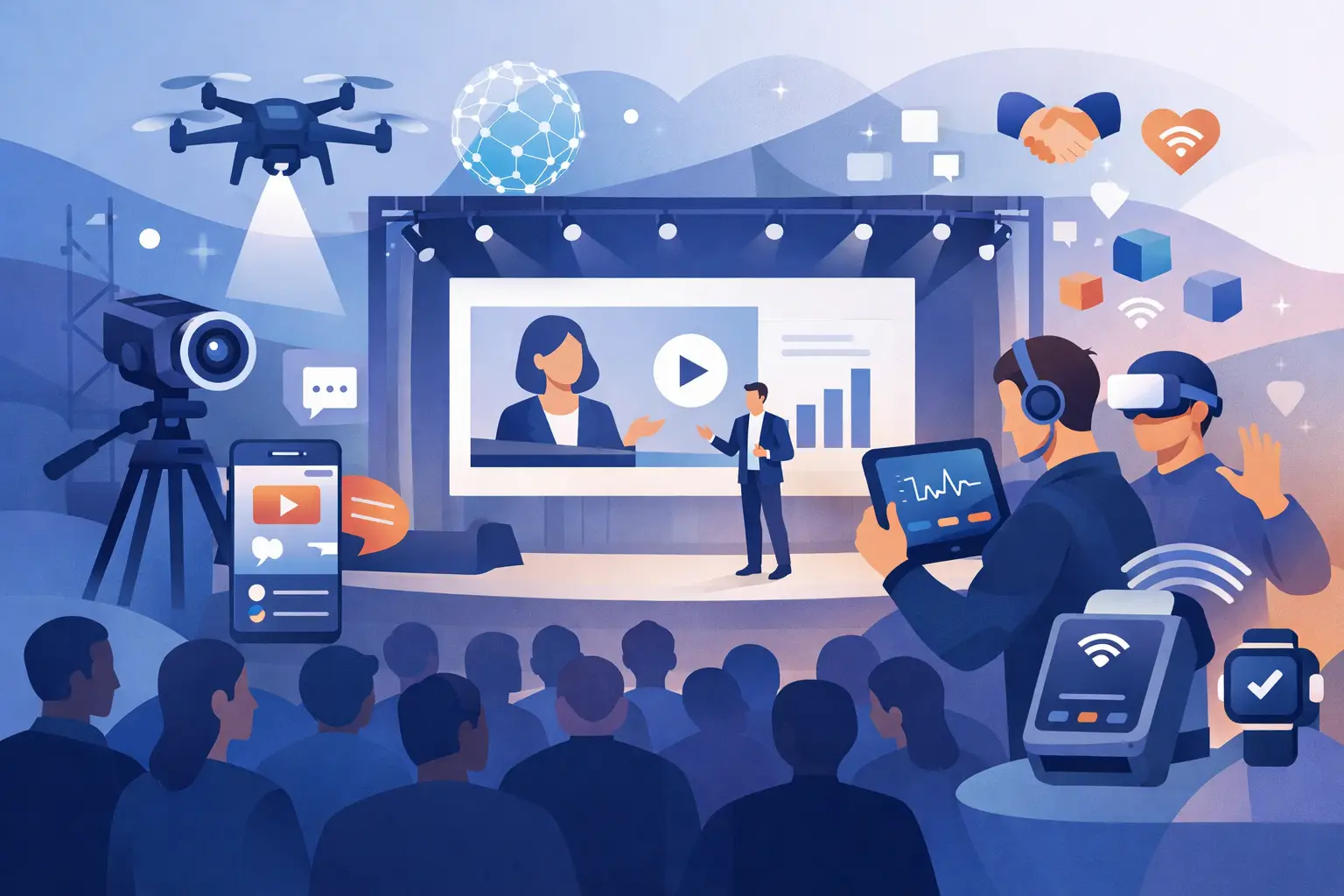
Event Technology Trends That Improve Live Events
A registration queue that moves slowly, an app nobody opens, or a screen that cannot be seen from the back of the room can undermine months of planning. The most valuable event technology trends are not about adding more devices to the venue. They are about removing friction, making a brand more visible, and giving organizers better control over the audience experience.
For conferences, exhibitions, corporate activations, and internal events, technology now needs to work as part of the full event environment. That includes the visual identity, venue layout, content strategy, production schedule, attendee journey, and post-event follow-up. The right investment supports all of them. The wrong one becomes an expensive feature with no practical role.
Event Technology Trends Shaping Better Experiences
The strongest trend is a shift from isolated technology to connected event systems. Decision-makers are asking a more useful question than, “What is new?” They are asking, “What will this improve?” A check-in tool should reduce arrival times. A digital display should guide guests or strengthen sponsor visibility. An event platform should help attendees find relevant sessions, people, and content.
This practical standard matters because live events are high-pressure environments. Production teams have limited time to test, venue conditions can change, and every guest interaction affects how the brand is perceived. Technology must be selected for reliability and purpose before novelty.
Smarter registration and access control
Fast, professional arrival experiences remain a priority. QR code check-in, self-service kiosks, badge printing, and RFID-enabled access can reduce congestion while providing useful attendance data. For exhibitions and large corporate events, these tools can also help teams understand visitor flow across zones, sessions, or activation areas.
The trade-off is that data capture requires planning. Registration fields should be relevant, consent processes should be clear, and onsite teams need a fallback process for guests whose details are missing or whose codes do not scan. A sophisticated system without trained support staff can create more stress than a well-managed registration desk.
Event apps designed around action
Event apps are becoming more focused. Rather than attempting to place every event function inside one platform, successful apps prioritize the actions attendees need most: viewing agendas, receiving updates, locating spaces, booking meetings, responding to polls, and accessing presentation materials.
Adoption depends on timing and usability. Asking guests to download an app at the venue entrance is rarely effective. Promote it during the registration journey, give people a clear reason to use it, and ensure the agenda and notifications are genuinely current. For a smaller leadership meeting, a branded web page and direct messaging may be more practical than a full app. The scale and audience behavior should determine the solution.
AI as a production assistant, not a replacement for judgment
Artificial intelligence is influencing event planning, content preparation, attendee support, and post-event reporting. It can help teams organize session information, draft audience communications, create first-pass event copy, summarize feedback, and identify common questions from attendees.
Its best role is to accelerate routine work while experienced people maintain control of brand voice, accuracy, and decision-making. AI-generated content still needs review, especially for executive events, regulated industries, bilingual communications, and public-facing brand messages. It can save time, but it cannot assess a venue, manage a last-minute production change, or replace an event manager’s understanding of the room.
Visual Technology Is Becoming Part of the Brand Experience
LED walls, projection mapping, interactive screens, and digital signage are no longer limited to large-scale entertainment events. They are increasingly used to create high-impact entrances, immersive product environments, dynamic stage backdrops, and exhibition stands that change throughout the day.
The opportunity is clear: digital surfaces can carry more content than static graphics and can be updated quickly. A branded screen can shift from welcoming guests to displaying session information, sponsor content, live social feeds, or product visuals. For organizations with multiple messages to communicate, that flexibility is valuable.
However, screen technology should never be treated as decoration alone. Brightness, pixel pitch, viewing distance, content format, power requirements, and sightlines all affect performance. A high-resolution display may be unnecessary for a distant stage backdrop, while a close-viewing exhibition screen requires sharper detail. Creative design and technical production need to be planned together from the start.
Interactive installations with a clear purpose
Touchscreens, product configurators, gamified challenges, AR displays, and photo experiences can attract attention at exhibitions and activations. They work best when they give visitors a reason to participate, not simply something to tap.
For example, an interactive product display can help visitors compare solutions and capture qualified leads. A team-building experience can turn company values into a memorable shared activity. A branded photo moment can extend visibility beyond the venue when it is designed with a strong visual identity and an easy sharing process.
The key is to match interaction to the event objective. If the goal is lead generation, the experience should connect participation to a simple, transparent data capture process. If the goal is internal engagement, it should create conversation and collaboration rather than isolate people behind screens.
Hybrid Events Are Evolving Into Content Systems
The demand for fully hybrid events has changed. Many audiences have returned to in-person gatherings because they value direct networking, live demonstrations, and the energy of a shared room. Yet the digital component remains essential for organizations that want to reach remote stakeholders, extend content life, or provide access across locations.
The more effective approach is not to duplicate every onsite experience online. It is to design two connected experiences. In-person guests may benefit from networking zones, physical demonstrations, and live audience interaction. Remote viewers need camera-aware presentations, strong audio, active moderation, and content that works on a smaller screen.
This makes video production and sound design critical. A professional stream cannot compensate for unclear presenters, poor lighting, or audio that captures room echo instead of speech. Events should be planned as productions, with run-of-show discipline, speaker preparation, backup connectivity, and technical rehearsals.
Recorded sessions also deserve a distribution plan. A keynote can become short social clips, a leadership message, an internal resource, or a follow-up asset for prospects. That is where event technology delivers value beyond event day: it turns a temporary gathering into reusable brand content.
Data Must Lead to Better Follow-Up
Organizers now have access to more event data than ever, from registration numbers and session attendance to lead scans, poll responses, app activity, and feedback scores. But collecting data is not the same as using it.
Before selecting a platform, define what decisions the data should support. A marketing team may want to identify high-interest prospects. A corporate communications team may need to measure content engagement. An exhibition organizer may want to understand visitor movement and peak traffic periods. Each objective requires different data points and a different follow-up process.
Data quality matters more than volume. A short, well-designed registration form and meaningful lead qualification questions can be more valuable than a large contact list with incomplete information. Teams should also agree in advance on ownership: who receives the data, how quickly they act on it, and how it connects to customer relationship management or sales activity.
Privacy should be treated as part of experience design. Attendees are more likely to share information when they understand why it is being collected and what they will receive in return. Clear communication builds trust while protecting the organization from avoidable risk.
How to Prioritize Technology for Your Next Event
Start with the audience journey, not the technology list. Consider how guests discover the event, register, arrive, navigate, participate, network, and receive follow-up. Then identify the moments where a better process, stronger visual communication, or more useful interaction would create a measurable improvement.
Next, assess the operational reality. Venue infrastructure, internet capacity, power access, installation windows, staffing, and contingency plans all influence what can be delivered confidently. A technology concept is only valuable when it can be executed consistently under live-event conditions.
Finally, protect brand consistency. Event screens, printed materials, signage, registration communications, stage content, and digital platforms should feel like one experience. This is where an integrated partner can reduce vendor fragmentation and improve quality control. T2 Arabia approaches event delivery as a connected process, aligning creative direction, technical production, branding, and onsite support around a single standard of execution.
The most successful event technology does not compete with the live experience. It makes the experience easier to navigate, more memorable to attend, and more valuable to the organization after the venue doors close. Choose the tools that help people participate with confidence, and the technology will have done its job.