12 Best Exhibition Display Ideas That Draw Crowds
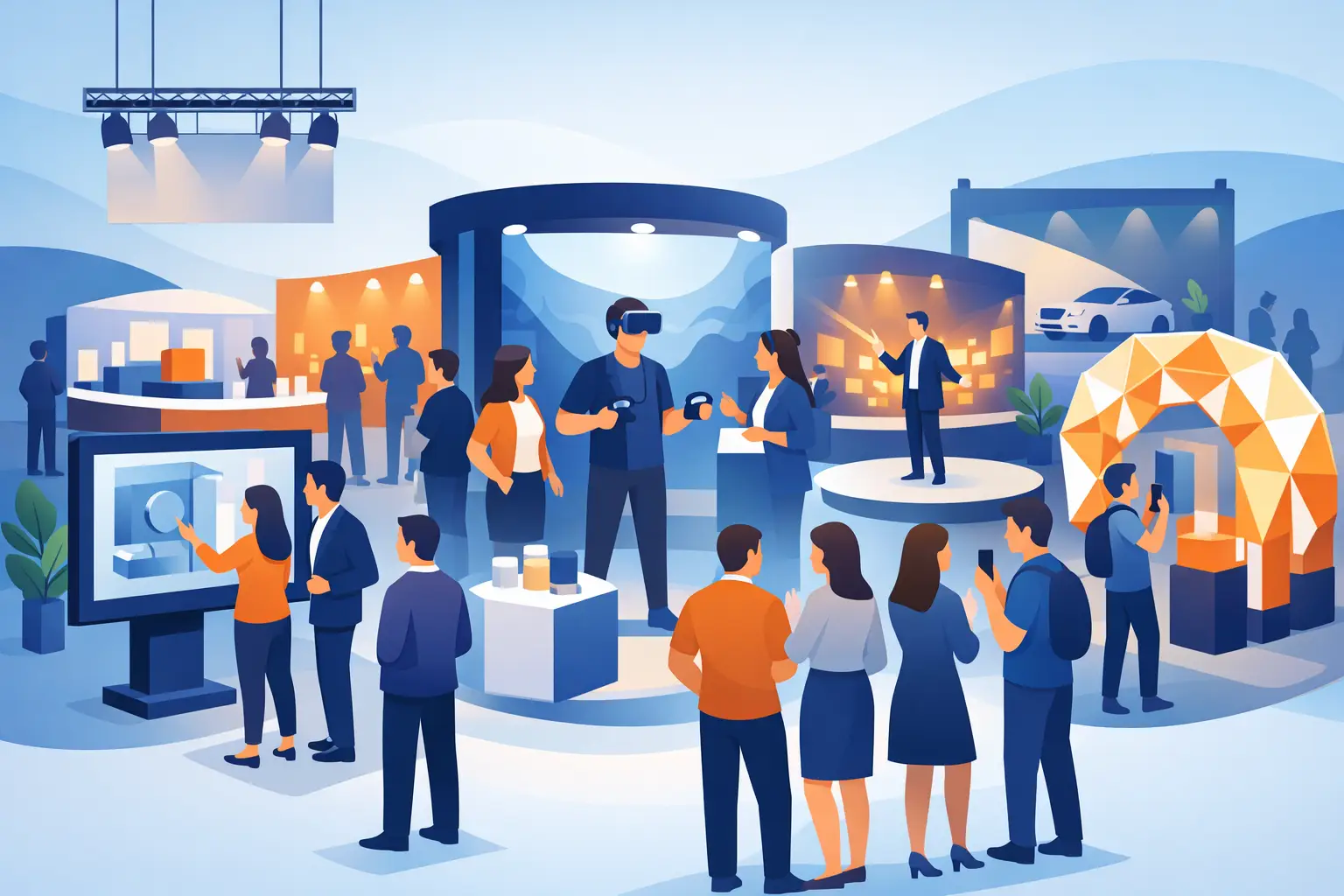
A busy exhibition floor gives visitors only a few seconds to decide where to stop. The best exhibition display ideas do more than look impressive from a distance. They make your value clear, create a reason to engage, and give your sales team an environment built for productive conversations.
For brands exhibiting in Saudi Arabia and across the Gulf, the right display must balance visual ambition with practical execution. It needs to represent the brand accurately, work within venue regulations, withstand long event hours, and support the goals behind the investment. Whether your priority is launching a product, generating qualified leads, or strengthening market presence, every display decision should serve a clear outcome.
Start With a Display Strategy, Not a Stand Shape
A larger booth is not automatically a stronger booth. A compact space with a focused message, excellent lighting, and an organized visitor journey can outperform a large build filled with competing graphics. Before selecting materials, screens, or furniture, define the action you want visitors to take.
Do you need them to test a product, request a consultation, attend a demonstration, or simply remember your name after the event? This decision guides the layout. It also prevents a common problem: a visually attractive stand that gives people no clear reason to stay.
Your exhibition display should support three layers of communication. From across the aisle, visitors should recognize your brand category or main promise. At the edge of the booth, they should see why your offer matters. Once inside, they should find the proof, product details, demonstrations, and people needed to continue the conversation.
Best Exhibition Display Ideas for Stronger Engagement
1. Build a Clear Hero Feature
Every effective stand needs one focal point. This could be a large product model, an architectural feature, an LED wall, a suspended sign, or an interactive installation. The purpose is not decoration for its own sake. It is to create immediate visual hierarchy so visitors understand where to look first.
A hero feature works best when it reflects a real brand asset or product advantage. A technology company might use a dynamic data visualization, while a developer could present a detailed scale model. Keep surrounding elements controlled. If everything is oversized, illuminated, and animated, nothing becomes memorable.
2. Use Layered Lighting to Create Presence
Lighting often determines whether premium materials and graphics are noticed at all. General venue lighting can flatten a display, particularly in large halls with neighboring booths competing for attention. Use a layered approach with ambient lighting for overall visibility, accent lighting for products or graphics, and task lighting for hospitality or meeting areas.
Backlit fabric walls and illuminated lettering deliver strong visibility without requiring excessive structural weight. Spotlights can make a product display feel more deliberate, while warmer lighting in a private meeting area can make discussions more comfortable. The trade-off is power planning and heat management, which should be resolved early with the production team.
3. Turn Product Demonstrations Into Live Moments
Static brochures explain. Live demonstrations persuade. If your product, software, equipment, or service can be shown in action, build a display around that experience. Create a visible demonstration zone with enough circulation space for observers, not only the person participating.
A scheduled demonstration every 20 or 30 minutes can create rhythm and draw a crowd. For more complex offers, use a large screen to make the experience visible to people outside the immediate area. Keep the presentation short, repeatable, and supported by staff who can move from demonstration to a qualified sales conversation.
4. Create a Walk-In Brand Environment
For brands with a strong story to tell, an immersive environment can be more effective than a conventional counter-and-wall setup. This might be a lounge designed around your industry, a walkthrough timeline of innovation, a simulated customer setting, or a sensory experience that connects visitors to the product.
Immersion should feel purposeful, not theatrical without direction. A hospitality brand may create a refined guest experience, while an industrial company may use materials, motion graphics, and sound to convey scale and capability. The key is continuity: the environment, staff uniforms, printed materials, and digital content should all communicate the same brand standard.
5. Make Data Visual, Not Dense
Corporate audiences want evidence, but exhibition visitors will not read a wall of text. Replace lengthy company histories and feature lists with concise visual proof. Use infographics, comparison panels, customer results, geographic reach, project milestones, or product performance metrics that can be understood quickly.
Digital screens are useful when content needs to change throughout the event, but they are not always the answer. Printed graphics remain highly effective for core messages that need constant visibility. The strongest approach often combines permanent brand messaging with screen content that adds movement, detail, and demonstrations.
6. Design a Socially Shareable Moment
A shareable feature can expand your exhibition impact beyond the venue, especially when it is connected to a genuine brand idea. Consider an interactive photo moment, personalized digital artwork, an augmented reality experience, or a bold sculptural installation that visitors naturally want to photograph.
Avoid generic photo backdrops with a logo placed in the corner. The feature should be recognizable as your brand even when it appears in a visitor’s image without a caption. It should also be easy to access. If the experience requires a long explanation or blocks the aisle, engagement will drop.
7. Use Suspended Signage for Long-Range Visibility
At large exhibitions, floor-level branding competes with dozens of other displays. Suspended signage provides a clear visual marker from across the hall and helps returning visitors find you after their first conversation. It is particularly valuable for island stands, large spaces, and brands located away from main entrances.
This option depends on venue rigging approval, installation schedules, and budget. When overhead signage is not possible, tall illuminated towers or carefully positioned backlit structures can create similar vertical presence. Planning these elements early is essential because venue restrictions can affect both design and production.
8. Add Private Meeting Space Without Closing the Booth
Many B2B exhibitors need confidential discussions, but fully enclosed rooms can make a booth feel uninviting. Use semi-private meeting areas with slatted partitions, frosted panels, acoustic materials, or elevated planting to create separation while preserving openness.
The best layout provides a clear transition from public engagement to focused conversation. A reception point can welcome walk-in visitors, a demo area can establish interest, and a meeting zone can support decision-making. This creates operational order for staff and a more professional experience for guests.
9. Give Visitors a Useful Reason to Pause
Hospitality remains valuable when it supports the brand experience. Comfortable seating, charging stations, refreshments, or a quiet workspace can generate longer interactions in demanding exhibition environments. However, these features must not turn the booth into a general lounge with no commercial purpose.
Place hospitality areas where staff can engage naturally, and use the space to support meetings, demonstrations, or content capture. The service should feel polished and intentional, reflecting the standard of the brand rather than functioning as an afterthought.
10. Bring Digital Content Into the Physical Build
The strongest event displays connect physical design with digital communication. QR-based product journeys, lead capture forms, personalized follow-up content, touchscreen catalogs, and real-time social displays can extend the visitor experience beyond the booth.
Technology should reduce friction, not create it. A touchscreen that requires several steps to reach basic information may slow engagement. Often, a simple scan that delivers a tailored brochure, booking option, or case study is more useful than an elaborate interface with limited practical value.
11. Prioritize Modular Elements for Repeat Use
A custom-built display creates impact, but not every event requires a completely new structure. Modular systems can be reconfigured across different stand sizes, updated with new graphics, and transported more efficiently. This approach is particularly useful for brands with a frequent exhibition calendar.
Modularity does not mean the booth must look generic. Custom finishes, lighting, signage, and content can give a reusable structure a distinct identity. The decision depends on how often you exhibit, how much your message changes, and whether consistency across multiple markets is a priority.
12. Plan the Visitor Journey With Your Team in Mind
A display is only as effective as the people operating it. Ensure staff have clear sightlines, practical storage, access to power and technology, and defined points for greeting, demonstrating, and meeting. Crowded counters, hidden storage, and unclear entrances create friction for both visitors and the event team.
Run through real scenarios before production is finalized. Where will a queue form during a demonstration? How will staff restock printed materials? Where can leads be captured without interrupting conversations? These details are where polished creative concepts become reliable exhibition operations.
Bring Every Element Together With One Standard
The difference between a good booth and a high-performing brand experience is coordination. Graphic design, fabrication, AV, printing, signage, staffing, logistics, and on-site support must work as one system. Fragmented suppliers can make this difficult, particularly when last-minute venue changes or technical issues arise.
T2 Arabia approaches exhibition production from concept to creation, combining creative development with the operational discipline required for confident delivery. The goal is not simply to fill a stand space. It is to create an environment where your brand looks credible, your team can work effectively, and your audience has a clear reason to engage.
The most valuable display idea is the one that visitors remember and your team can use with confidence. Choose features that reinforce your message, invest in details that improve the experience, and build for the business conversation you want to have when the exhibition floor gets busy.