
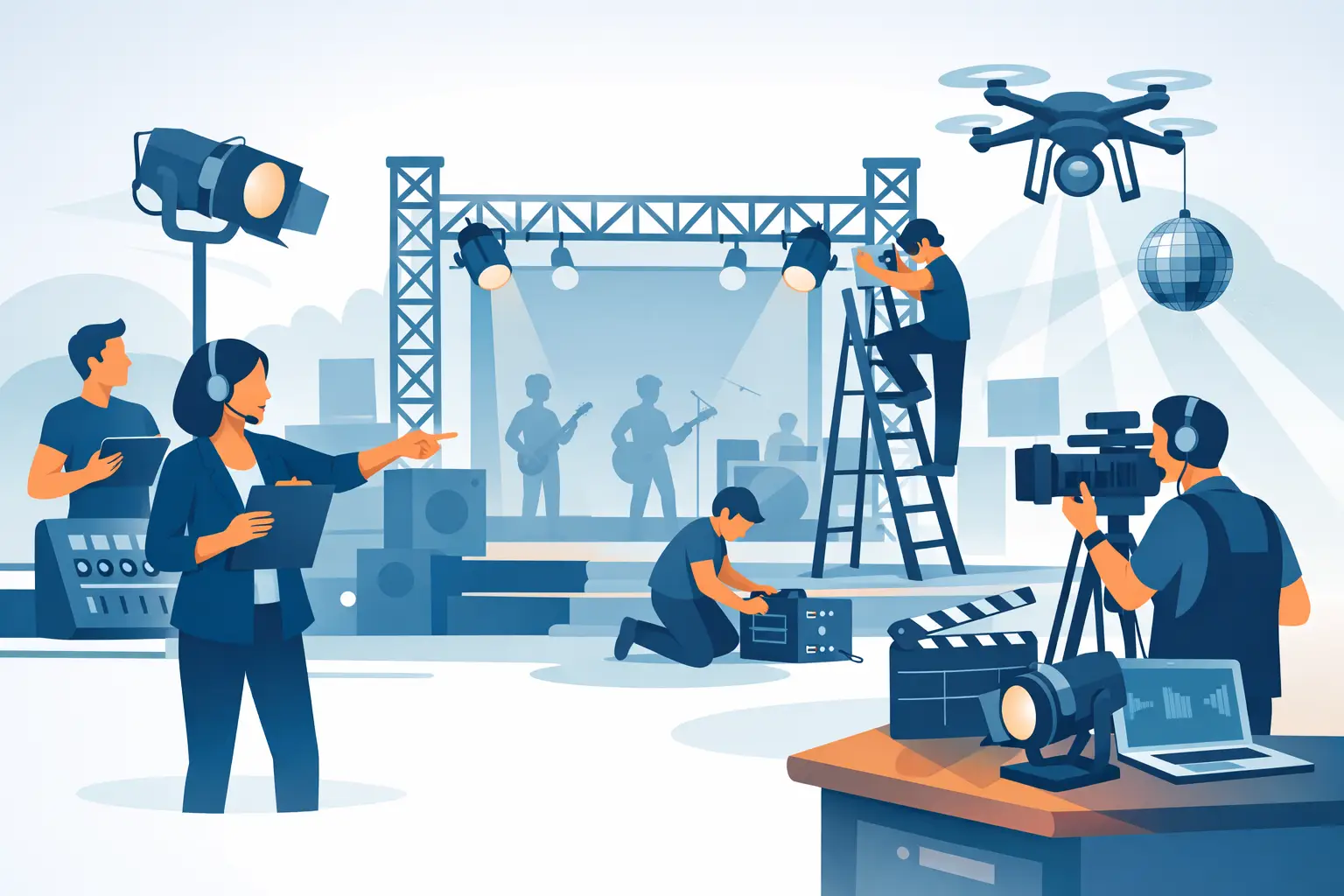
What an Event Production Company Really Does
A crowded expo hall, a high-stakes product launch, a leadership summit with multiple stakeholders – this is where an event production company proves its value. Not by supplying isolated services, but by bringing structure, creative direction, technical control, and on-site precision to every moving part.
For many organizations, the challenge is not coming up with an event idea. It is translating that idea into an experience that looks right, runs on time, reflects the brand, and supports real business goals. That gap between concept and execution is where production matters most.
Why an event production company matters
An event is never just a stage, a screen, or a schedule. It is a live brand environment made up of design decisions, logistics, audience flow, AV systems, signage, staffing, timing, and contingency planning. When those pieces are managed separately by different vendors, the result is often slower approvals, inconsistent branding, avoidable delays, and budget leakage.
A capable event production company brings those functions together. That does not simply make the process more convenient. It improves quality control. Creative intent stays aligned with technical delivery. Production timelines support marketing deadlines. On-site decisions are made faster because responsibility is clear.
This is especially important for companies managing exhibitions, conferences, internal engagement programs, roadshows, and branded activations. These formats carry visible pressure. Guests, partners, executives, and prospects all experience the brand in real time. There is no room for fragmented execution.
What an event production company actually handles
The work usually begins well before the venue is booked or the first render is approved. Production starts with understanding the business objective. Is the event meant to generate leads, build visibility, support employee engagement, launch a product, or strengthen partner relationships? The answer shapes every practical decision that follows.
Strategy, concept, and experience planning
At the front end, production teams help define the event format, audience journey, spatial requirements, visual direction, and key moments of engagement. This stage is often underestimated, but it has direct operational value. Clear concept development reduces revisions later and prevents attractive ideas from turning into impractical builds.
For example, a brand activation designed for social sharing needs more than visual impact. It needs traffic flow, lighting that works on camera, clear signage, and interactive elements that do not create bottlenecks. A conference requires a different structure – content timing, speaker support, stage visibility, and technical redundancy matter more.
Technical production and build execution
Once the concept is defined, the event production company translates it into physical and technical reality. That includes staging, audio, video, lighting, scenic fabrication, exhibition structures, graphics, power planning, and venue coordination. This is where experience turns into systems, measurements, schedules, and approvals.
Good production is rarely loud about itself. Guests notice the screen content, the atmosphere, and the polish. They do not always see the cable routing, load-in planning, rehearsal management, or backup equipment strategy behind it. But those details are exactly what protect the event from visible failure.
Branding, print, and signage integration
One of the biggest differences between a general event organizer and a fully integrated production partner is brand consistency. Events rely on far more than one backdrop and a logo on screen. Wayfinding, registration areas, exhibition graphics, printed materials, product displays, and environmental branding all shape perception.
When branding, signage, and print production are developed in parallel with event planning, the result is sharper and more efficient. Colors match across materials. Messaging stays consistent. Installation planning is built into the timeline instead of becoming a late-stage scramble.
On-site management and operational control
Even the strongest pre-production plan still needs disciplined execution on event day. Timings shift. VIP arrivals change. A presenter wants updated content. A booth element needs adjustment. Guests gather in one zone and leave another underused. The real test is how quickly and calmly the production team responds.
An experienced company manages those moments through clear command structure, technical supervision, crew coordination, and live problem-solving. This is where reliability becomes tangible. Clients do not need more activity around them. They need control, accountability, and confidence that the event is being managed professionally.
The real cost of fragmented event delivery
Some businesses still divide their event work across separate suppliers for AV, fabrication, branding, printing, digital assets, and staffing. In certain cases, that can work – especially for smaller events with minimal production complexity or when an internal team has strong oversight capacity.
But for larger or brand-sensitive projects, fragmentation usually creates friction. Each vendor protects its own scope. Timelines become harder to coordinate. Design adjustments have ripple effects that nobody fully owns. If something goes wrong, accountability becomes blurred.
A single production partner does not automatically mean lower cost in every line item. It often means lower waste. Fewer handoff errors, fewer duplicate processes, fewer urgent fixes, and a more coherent final result. For decision-makers balancing budgets against visibility and execution quality, that trade-off matters.
Choosing the right event production company
Not every provider is built for the same kind of work. Some are strongest in entertainment-heavy shows. Others focus on exhibitions, corporate events, or retail activations. The right fit depends on your event type, your internal resources, and how closely the event needs to align with wider brand activity.
Look beyond equipment lists
It is easy to be impressed by inventory or visual highlights. Those matter, but they are only part of the picture. A dependable partner should also show strength in planning discipline, project management, venue coordination, and brand understanding. Great equipment does not compensate for weak communication or reactive execution.
Ask how the team approaches timelines, approvals, technical rehearsals, content management, and contingency planning. Those answers reveal more than a glossy portfolio ever will.
Prioritize integration if your event supports brand growth
If your event also requires exhibition graphics, printed collateral, digital event assets, web support, or environmental branding, integration becomes a strategic advantage. It keeps quality high and reduces the burden on your internal team.
This matters even more for businesses running recurring events or regional campaigns. Reusable brand systems, consistent production standards, and centralized coordination make scaling much easier over time.
Judge responsiveness as seriously as creativity
Creativity wins attention, but responsiveness protects delivery. In live production, delays in approvals, unclear updates, or weak issue handling can create expensive problems very quickly. A strong event production company combines ideas with discipline. It knows how to move from concept to creation without losing precision.
That balance is especially valuable in fast-moving business environments where multiple departments are involved and stakeholder expectations are high.
What strong production looks like in practice
The best event outcomes feel intentional from start to finish. Registration is clear. Branded surfaces look consistent. Stage content is visible and well timed. Sound is balanced. Staff know where to be. Guests can move naturally through the space. Nothing feels improvised, even when adjustments happen behind the scenes.
That level of control comes from connecting creative, technical, and operational work rather than treating them as separate tasks. It is the difference between an event that simply takes place and one that actively supports reputation, engagement, and business momentum.
For organizations that value polished execution, working with one experienced partner can simplify far more than event day. It can shorten planning cycles, improve stakeholder confidence, and create a stronger brand presence across every touchpoint. That is why companies looking for consistency, accountability, and quality often turn to an integrated specialist such as T2 Arabia.
A well-produced event should never feel like a collection of vendors. It should feel like one clear vision, delivered with control.