
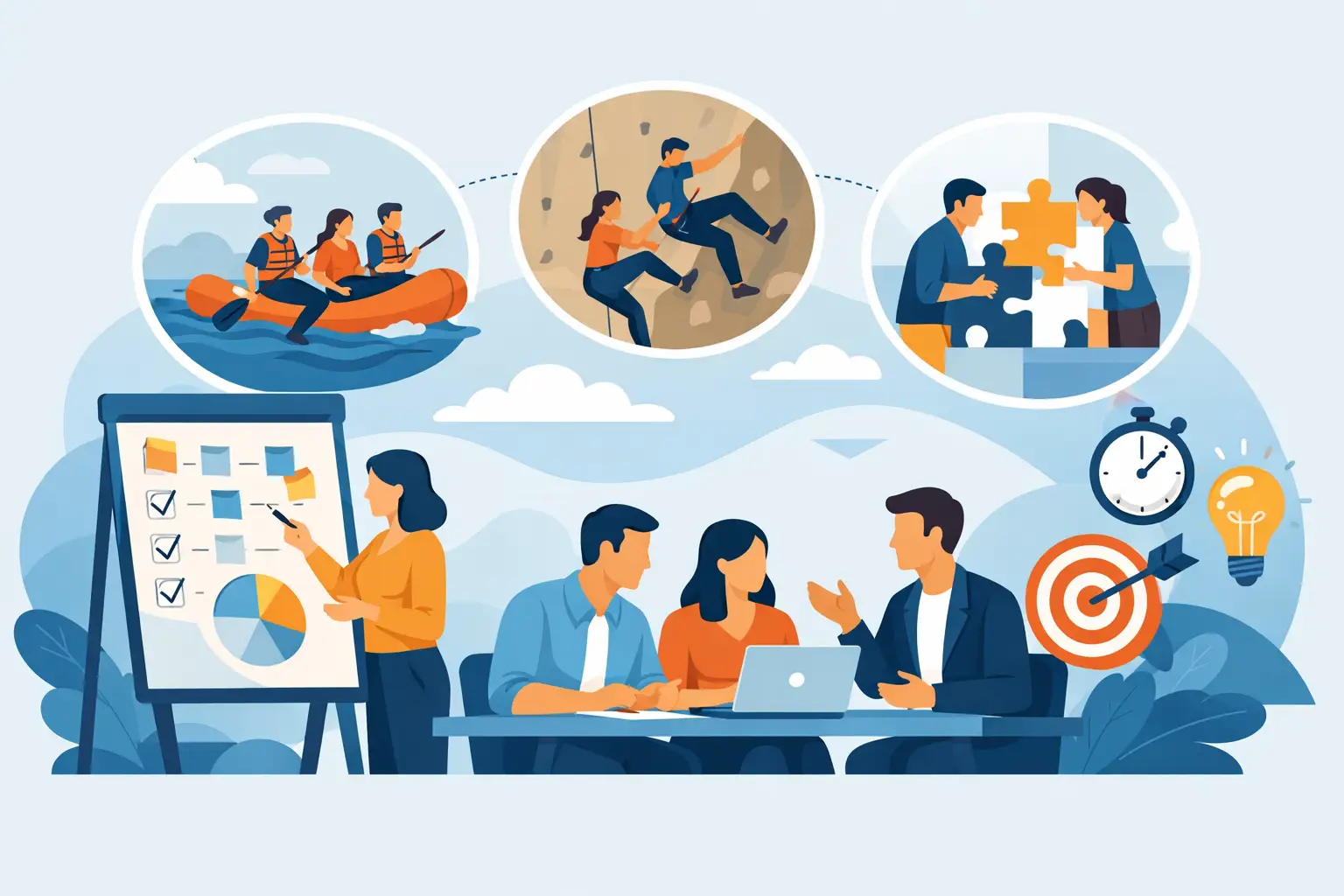
Team Building Activity Planning That Works
A team event can look impressive on paper and still miss the mark by 10:30 a.m. The issue is rarely effort. More often, team building activity planning starts with the activity instead of the outcome. When the goal is vague, the experience feels disconnected, and even a well-produced event becomes just another date on the calendar.
For organizations investing in internal engagement, the standard should be higher. A successful team-building program should strengthen collaboration, reflect company culture, and justify the time your people step away from daily operations. That requires more than booking a venue and selecting a game. It requires a clear plan, disciplined execution, and a format built around the people in the room.
Why team building activity planning often falls short
Many companies approach team building with good intentions but weak alignment. HR may want morale improvement, leadership may want stronger cross-functional communication, and department heads may simply want an event that employees will actually enjoy. All three goals are valid, but they produce very different event structures.
This is where planning becomes strategic. If the event is meant to improve trust after a period of change, the format should encourage open communication and shared problem-solving. If the goal is recognition and energy, the event can be more celebratory and fast paced. If the objective is culture integration after growth or restructuring, the design should create meaningful interaction between teams that do not normally work closely together.
The trade-off is simple. A broad, generic activity may be easier to arrange, but it usually delivers generic results. A targeted experience takes more planning, yet it creates clearer value and stronger engagement.
Start with business outcomes, not activity ideas
The strongest team building activity planning begins by defining what success looks like. That sounds obvious, but it is often skipped in favor of brainstorming venues, themes, or entertainment.
A better starting point is to ask a few practical questions. What has changed in the organization recently? Where are teams experiencing friction? What kind of behavior should this event encourage after it ends? Those answers shape every planning decision that follows.
If your organization is preparing for a major launch, a collaborative challenge tied to speed, coordination, and communication may support the moment. If the company is focusing on retention, a program that balances recognition, inclusion, and relaxed interaction may be more effective. If leadership wants teams to feel more connected to the brand, the activity should reflect company values in a visible, well-produced way.
That is one reason many businesses prefer working with a single execution partner. When strategy, production, branding, and event operations are aligned from the beginning, the final experience feels intentional rather than assembled from separate parts.
Match the format to the audience
A senior leadership retreat, a mixed-department employee engagement day, and a large corporate activation should not be planned in the same way. Audience shape matters as much as budget.
For smaller executive groups, the value often comes from focused interaction. The setting can be more refined, the pacing can be slower, and the activities can leave space for discussion. For larger employee groups, momentum and clarity become more important. Instructions need to be simple, transitions need to be smooth, and the event flow needs to keep energy high without feeling forced.
In the Gulf market especially, audience planning should also consider cultural context, internal hierarchy, language comfort, and gender inclusion where relevant. A format that works well for one corporate environment may feel out of place in another. Strong planning respects those realities without losing creativity.
The logistics behind a smooth experience
Creative concepts get attention, but logistics protect the experience. This is where many team-building events either gain credibility or lose it.
Venue selection should support the activity, not compete with it. A space that looks impressive but creates poor movement, limited visibility, or sound issues will undermine even the strongest concept. Timing matters as well. An event scheduled at the wrong point in the week or during a high-pressure business period can reduce participation before the program even begins.
Production planning also deserves more attention than it typically gets. Registration flow, signage, stage management, audiovisual support, branded materials, staffing, and contingency planning all affect how professional the event feels. Participants may not notice each production detail individually, but they absolutely notice when those details are missing.
That is why execution quality matters so much in internal events. Employees are not passive attendees. They immediately read the room. If the event is organized with care, it signals respect for their time. If it feels rushed or fragmented, the message is equally clear.
Team building activity planning should protect your brand
Internal events are still brand experiences. They may not face the public, but they shape how employees perceive the company and how confidently they represent it.
That means visual consistency matters. Messaging matters. The way the event is introduced, branded, staged, and documented matters. Even seemingly simple team-building sessions can reinforce professionalism when every touchpoint feels connected to the company identity.
This does not mean every event needs heavy branding. In some cases, a lighter touch is more appropriate. But even a minimal approach should be deliberate. Colors, signage, presentation materials, participant kits, and digital communication should feel coordinated. A well-branded internal event strengthens trust because it shows that culture-building is being handled with the same care as external visibility.
For organizations managing exhibitions, conferences, and employee engagement under one wider brand strategy, this integration becomes even more valuable. It reduces inconsistency and keeps every experience moving in the same direction.
Build for participation, not performance
One common mistake in team building activity planning is choosing formats that ask people to perform socially instead of participate meaningfully. Not every group responds well to highly theatrical icebreakers or forced enthusiasm.
The better approach is to create structured interaction with a clear purpose. Problem-solving exercises, collaborative challenges, creative build sessions, and scenario-based activities often work better because they give people something to do together, not just something to say. Participation becomes more natural when the activity itself creates momentum.
It also helps to calibrate intensity. Some teams enjoy competition. Others respond better to shared goals and lower-pressure interaction. Neither is universally right. It depends on culture, team maturity, and recent business context. A sales organization may thrive in a fast, competitive format. A cross-functional group rebuilding alignment after internal change may need something more collaborative and balanced.
Measure impact in a practical way
Not every team-building result can be measured immediately, but that does not mean impact should remain vague. Good planning includes a practical way to evaluate the experience.
That may include post-event feedback, manager observations, attendance quality, participation levels, or follow-up indicators tied to the original objective. If the event was designed to improve cross-team familiarity, ask whether new connections were made. If the goal was morale, look at engagement feedback and employee response in the days that follow. If the event supported a wider brand or culture initiative, assess whether participants clearly understood the message.
The point is not to over-engineer the evaluation. It is to make sure the event is treated as a purposeful investment rather than a one-off activity.
Why execution partner choice changes the result
Team building is often underestimated because it appears simpler than a conference or exhibition. In reality, it can be harder to get right. Corporate audiences are discerning, internal goals are often layered, and the margin for disengagement is small.
That is why partner choice matters. A capable event partner does more than source activities. They help define objectives, shape the experience around your audience, manage production details, maintain brand consistency, and keep execution under control from planning through delivery. For organizations that want one accountable partner across events, branding, print, signage, and digital support, that structure removes friction and improves quality across the board.
At T2 Arabia, that integrated model is central to how complex event experiences are delivered. It allows planning decisions to move faster and keeps the final result more cohesive.
The strongest team-building events do not happen because a popular activity was chosen. They work because every detail supports a clear purpose. When planning is thoughtful, branding is consistent, and execution is disciplined, the event does more than entertain people for a few hours. It gives teams a shared experience that feels worth having.