
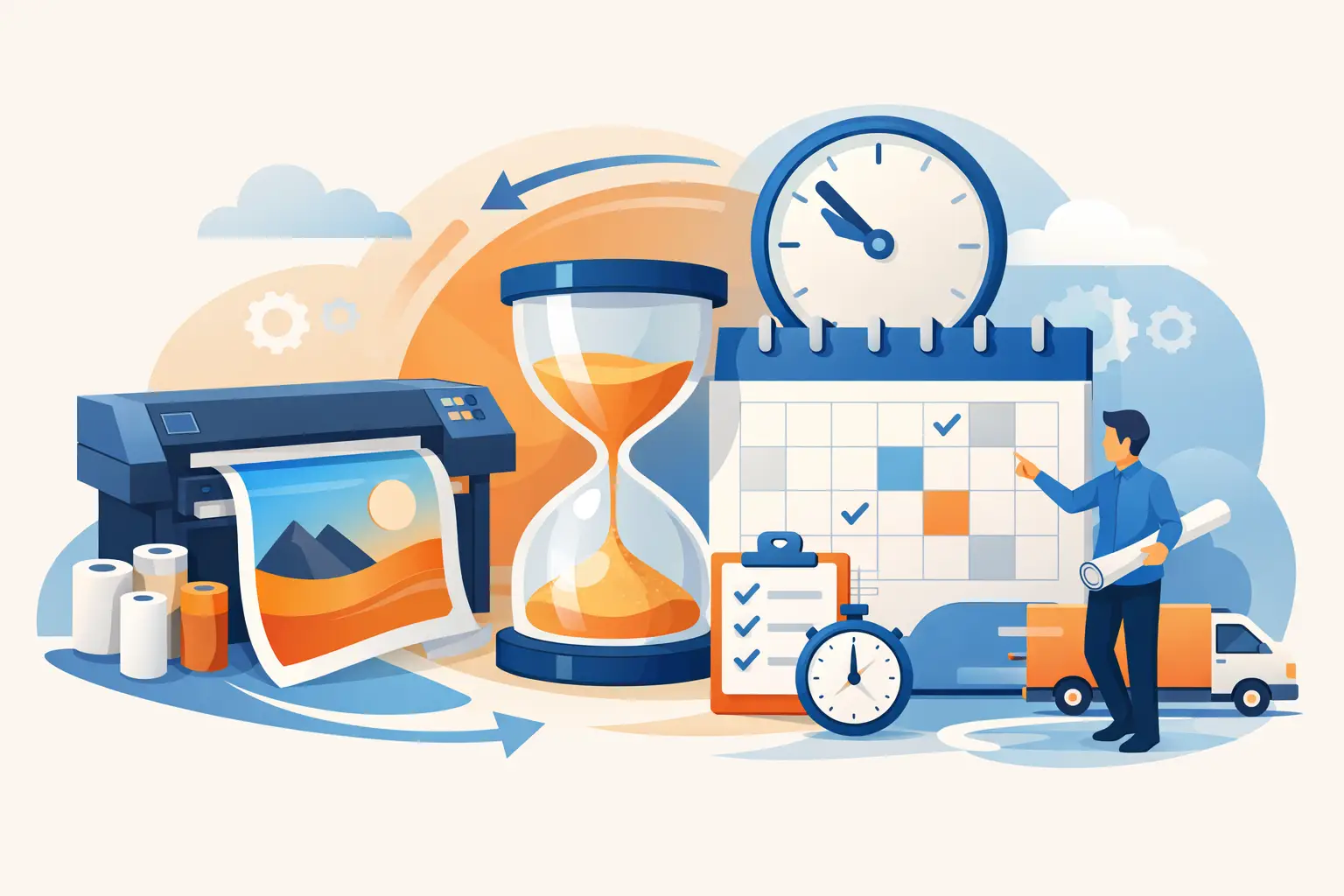
Banner Printing Turnaround: Plan for Every Deadline
A banner that arrives on time but cannot be installed correctly is not a successful print job. For exhibition teams, campaign managers, and event organizers, banner printing turnaround is a coordinated production process that begins well before the printer starts running. The deadline must account for artwork approval, material selection, finishing, quality control, delivery, site access, and installation.
A clear production plan protects more than the event schedule. It safeguards brand consistency, prevents costly last-minute changes, and gives every stakeholder confidence that the final environment will look as intended. Whether the project involves a single promotional banner or a complete exhibition package, speed works best when it is supported by preparation.
What Determines Banner Printing Turnaround?
Turnaround is often described as the number of days between placing an order and collecting the final print. In practice, that definition is too narrow. A banner may be printed quickly, but the overall project can still be delayed by late artwork, an incorrect substrate, unavailable hardware, or a venue that restricts delivery times.
The most reliable schedule considers the full route from approved design to installed asset. This is particularly relevant for conferences, trade shows, retail launches, corporate activations, and outdoor campaigns, where multiple branded elements must arrive together and perform in a specific environment.
Artwork readiness comes first
Print-ready artwork is the starting point for a predictable production timeline. Files should be supplied at the final output size or built proportionally, with sufficient resolution for the viewing distance. A large-format banner viewed from several feet away does not require the same image resolution as a brochure, but low-quality source images can still create visible pixelation and weak color detail.
Design teams should also confirm bleed, safe margins, scale, fonts, linked images, and color settings before production begins. Text, logos, and key visual elements should stay clear of hems, eyelets, pole pockets, and trim areas. If the banner will be stretched onto a frame, the artwork must allow for the portion that wraps around the edges.
A proofing step may add time, but it is often the fastest way to avoid reprints. Color expectations deserve particular attention when banners sit alongside exhibition walls, branded counters, backdrops, brochures, or digital displays. A logo that looks correct on a monitor may shift when printed on fabric, vinyl, or mesh.
Material choice changes the schedule
The material affects production time, visual finish, durability, and installation method. Indoor banners may prioritize smooth texture, vivid color, and a premium presentation. Outdoor applications require stronger resistance to wind, sunlight, and moisture. A mesh banner, for example, allows air to pass through and can be a better choice for exposed locations, while a solid vinyl banner may deliver greater visual density in sheltered spaces.
Fabric banners can create an elevated look for events and exhibitions, especially where lighting, photography, and close viewing matter. However, fabric printing, sewing, steaming, and hardware preparation may follow a different timeline than standard vinyl production. Rigid signage, tension-fabric systems, and illuminated displays also require more assembly and technical coordination.
The right question is not simply, “What can be printed fastest?” It is, “What material will deliver the right result at the required location, for the required duration?” Choosing the wrong substrate to save a day can create a larger problem on site.
Finishing is part of the production, not an afterthought
A printed banner is only one component of a functional display. Finishing may include hemming, eyelets, pole pockets, sewn edges, Velcro, silicone edging, mounting tape, or custom frame preparation. Each option determines how the banner hangs, stretches, or connects to its surrounding structure.
For a simple wall banner, eyelets and reinforced hems may be sufficient. For a stage backdrop, tension, sightlines, lighting, and structural safety require greater attention. For an exhibition stand, the banner may need precise dimensions to fit a modular frame or a custom-built façade. These details must be confirmed before print production, not when the installation crew is already at the venue.
How to Build a Reliable Banner Printing Timeline
A dependable schedule starts by working backward from the moment the banner needs to be installed. Installation day is not the delivery deadline. It is the final operational checkpoint, and it should include time for unloading, access approvals, assembly, positioning, adjustments, and a visual inspection.
For high-visibility events, build in a buffer before the venue handover. This buffer allows the team to resolve issues such as a damaged package, a last-minute dimension change, an obstructed mounting area, or a mismatch between approved drawings and actual site conditions. It also gives photographers, brand managers, and event leads time to review the finished presentation before guests arrive.
A practical production timeline typically moves through design completion, client approval, prepress checks, printing, finishing, quality control, packing, transport, and installation. The number of working days required depends on volume and complexity. A standard banner with approved artwork may be produced rapidly, while a complete branded environment with custom structures and multiple display formats needs more lead time.
When deadlines are fixed, prioritize early decisions on size, material, mounting, and artwork ownership. Delays often happen because one person assumes another team is approving the final file, arranging venue access, or supplying the correct dimensions. A single production owner who coordinates these decisions can prevent fragmented communication and unnecessary rework.
When Rush Printing Makes Sense
Rush production has a legitimate role. Campaign changes, unexpected speaking opportunities, last-minute sponsorships, and event updates are common realities. A capable print partner can often accelerate straightforward jobs when files are correct, stock is available, and the finishing requirements are clear.
Still, rush printing involves trade-offs. Material options may be limited, custom finishes may not be feasible, and there may be less time for proofs or revisions. Delivery costs can increase, especially when projects require dedicated transport or after-hours venue access. The fastest option is not always the strongest option for a premium event environment.
Rush work is most effective when the scope is tightly controlled. Keep the format standard, use approved brand assets, avoid unnecessary structural changes, and confirm the installation method at the outset. If a banner is replacing an existing asset, provide photos and exact measurements of the mounting position so the production team can prepare the correct finish.
Banner Printing Turnaround for Events and Exhibitions
Events introduce variables that ordinary print jobs do not. A banner can be perfectly produced and still fail if it does not fit the stand, comply with venue rules, or arrive during the approved loading window. Event teams need printing and production to operate as one coordinated workflow.
For exhibitions, consider the banner alongside booth construction, electrical points, audiovisual equipment, furniture, flooring, lighting, and visitor flow. The most impactful graphics are not necessarily the largest. They are the ones placed where attendees can read them quickly, understand the message, and connect the visual treatment to the wider brand experience.
For outdoor activations, assess weather exposure, fixing points, local permissions, and viewing conditions. Wind load can affect both the material and mounting solution. For indoor conferences, consider stage lighting and camera angles. Glossy surfaces may reflect light, while dark graphics can lose detail under uneven illumination.
T2 Arabia approaches print as part of the full brand environment, connecting banners with event production, signage, exhibition execution, and on-site support. This integrated approach reduces handoffs between suppliers and helps ensure the printed asset performs as intended when it matters most.
Questions to Ask Before You Approve Production
Before giving final approval, confirm the exact finished dimensions, the material, the intended location, and the mounting method. Check whether the banner will be viewed indoors or outdoors, from close range or across a hall, in daylight or under event lighting. These answers affect both the creative file and the production route.
Also confirm who is responsible for delivery and installation. A banner delivered to a loading dock is not necessarily delivered to the event space. Venues may require permits, insurance documents, specific delivery windows, or approved contractors. Build these operational requirements into the schedule from the beginning.
Finally, agree on a clear approval process. One approved file, one authorized contact, and one documented production specification reduce the risk of conflicting instructions. This discipline is especially valuable when marketing, procurement, event operations, and external agencies are all involved.
The strongest banner projects do not rely on last-minute speed alone. They combine approved creative, appropriate materials, precise finishing, and site-ready logistics so the brand is visible, polished, and ready when the audience arrives.